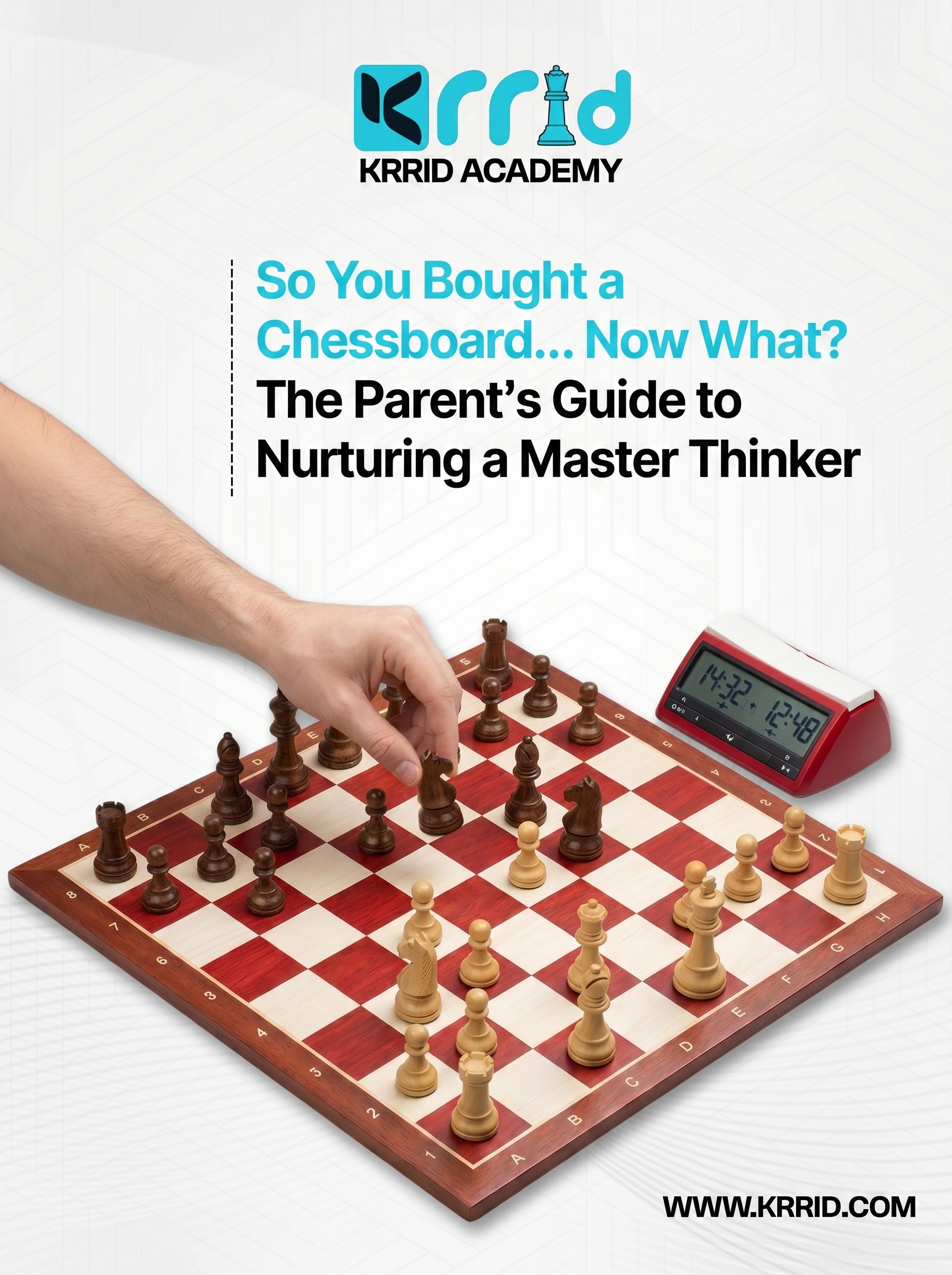
So You Bought a Chessboard… Now What? The Parent’s Guide to Nurturing a Master Thinker
Nikhil S, Senior Child Development & Chess Pedagogy Expert
April 20, 2026
If you’ve been following our journey, you already know the secret: before we teach our kids to code, we need to teach them how to think. You’ve likely read the research, understood the profound cognitive benefits of impulse control, spatial reasoning, and resilience, and finally took the plunge.
You bought a chessboard.
You sat down at the kitchen table. You taught your seven-year-old that the rook moves in straight lines and the knight moves in a funky "L" shape. You played a few games. They laughed, you laughed, and a pawn was tragically eaten by the dog.
But fast forward three weeks, and a familiar story unfolds. The board is gathering dust on a shelf next to Monopoly. When they do play, they just push pieces forward randomly until someone loses. The excitement has faded, and the cognitive benefits are stalling.
As a child development and chess expert, I see this all the time. It’s what I call the "Beginner’s Plateau."
Here is the truth: Knowing how the pieces move is not the same as knowing how to play chess. And more importantly, to unlock the true brain-boosting power of the game, a child needs structure, progression, and a guide.
Here is why your child’s chess journey needs to evolve past the kitchen table, and how to make it happen without adding stress to your busy schedule.
**1. The "Parent-Teacher" Trap
**Let’s be honest: teaching your own child can be incredibly frustrating. The dynamic that makes you a great parent often makes you a terrible coach for your own kid. When a parent tries to correct a chess blunder, a child often hears criticism rather than instruction. Tears happen. Boards get flipped.
By outsourcing the instruction to a neutral, expert third party, you remove the emotional friction. You get to go back to being their biggest cheerleader, while a professional handles the "why moving your queen out on turn two is a bad idea" conversation.
**2. The Danger of Unstructured Play
**When children play chess without learning underlying strategies—like controlling the center, developing minor pieces, or king safety—they hit a wall. They lose repeatedly to older siblings or schoolmates, and because they don’t have the analytical tools to understand why they lost, they assume they just aren't "smart enough."
Structured learning prevents this. A good curriculum introduces bite-sized strategic concepts, giving children "Aha!" moments that fuel their confidence and keep them coming back to the board.
**3. Turning "Screen Time" into "Brain Time"
**In my previous article, I praised the physical chessboard. I stand by that—tactile learning is vital. But how do you find a world-class chess coach in your local neighborhood who fits your Tuesday afternoon schedule? Often, you can't.
This is where technology serves its highest purpose. You don't have to choose between offline benefits and online convenience. The modern solution is hybrid: your child sits with their physical board at home, while engaging with a live, expert coach on a screen. The screen ceases to be a passive distraction and becomes an interactive classroom.
Enter Krrid: The Ultimate Ecosystem for Young Minds
This is exactly why we built Krrid.
We saw thousands of parents who wanted the developmental benefits of chess for their children but lacked the time, expertise, or local resources to make it happen.
At Krrid - Online Chess Academy, we don’t just teach chess; we build thinkers.
Here is how we turn your child's casual interest into a lifelong cognitive advantage:
World-Class Coaches, Child-Friendly Pedagogy: Our instructors aren't just chess masters; they are trained educators who know how to keep a 7-to-12-year-old engaged, laughing, and learning.
A Structured, Gamified Curriculum: We break down complex strategies into digestible, fun lessons. Your child will see their progress, earn achievements, and feel a deep sense of mastery.
**Safe, Moderated Peer Play: **At Krrid, your child isn't playing faceless avatars on the internet. They are joining a global community of kids in safe, moderated online tournaments and practice rooms.
Total Convenience for Parents: No driving through rush hour traffic to reach a community center. High-quality brain training happens right in your living room, on your schedule.
The Next Move is Yours
You took the critical first step by introducing your child to the board. Don't let the momentum stop there. Give them the tools, the guidance, and the community to actually master the game—and in doing so, master their own minds.
*Ready to see the Krrid difference? *Don't let that chessboard gather dust. Turn your child's curiosity into confidence.
👉 https://www.krrid.com/book-demo and watch your child make their best move yet.